
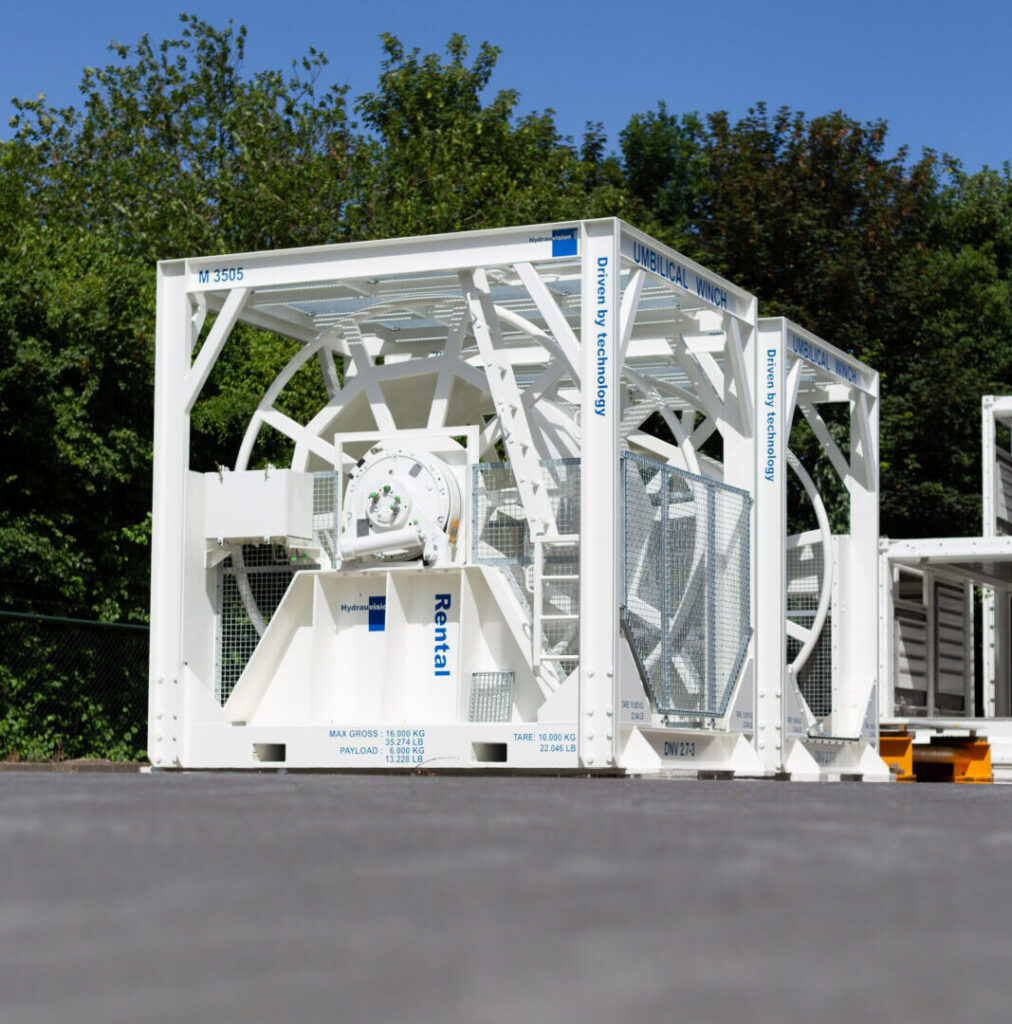
Active heave compensation (AHC) in a hydraulic winch is a system that automatically counteracts the vertical motion of a vessel caused by waves, keeping a suspended load stable relative to the seabed or a fixed reference point. The winch continuously pays out or retracts wire in real time to cancel the vessel’s heave movement. This technology is widely used in offshore operations where precise load control in dynamic sea conditions is not just helpful but operationally necessary.
Below, we answer the most common questions about AHC hydraulic winches, from how the system works to what to look for when selecting one for your project.
How does active heave compensation work in a hydraulic winch?
An AHC hydraulic winch works by measuring the vessel’s vertical motion using motion reference units (MRUs) and then commanding the winch drum to move in the opposite direction at the same speed and amplitude. The result is that the wire length between the winch and the load adjusts continuously, so the load remains effectively stationary even as the vessel rises and falls with the waves.
The hydraulic drive system is central to this capability. Hydraulic drives can deliver high force with very fast response times, making them well suited to the rapid, precise movements that heave compensation demands. The control system processes MRU data and translates it into valve commands that adjust flow to the hydraulic motor driving the winch drum, typically within milliseconds. This closed-loop feedback continues throughout the operation, constantly correcting for any deviation between the desired load position and the actual position.
Because the system operates continuously and automatically, the operator does not need to manually compensate for vessel motion. This reduces operator fatigue and significantly lowers the risk of shock loading on the wire, the load, or the structure being worked on.
What is the difference between active and passive heave compensation?
The key difference is that active heave compensation uses powered, real-time control to counteract vessel motion, while passive heave compensation relies on stored energy in a hydraulic accumulator system to absorb and release motion without active input. Active systems are far more precise; passive systems are simpler and require less energy but offer less control.
In a passive system, the winch wire is connected through a hydraulic accumulator that acts like a spring. As the vessel heaves upward, the accumulator absorbs the energy; as the vessel drops, it releases it. This reduces shock loads and provides a degree of motion isolation, but it cannot actively track or cancel the vessel’s movement. The load will still move somewhat with the vessel.
An active system, by contrast, drives the winch drum with powered hydraulic motors controlled by the MRU feedback loop. It can achieve near-zero relative motion between the load and the seabed. The trade-off is higher system complexity, greater energy consumption, and more sophisticated control software. Many offshore hydraulic winches are designed to operate in both modes, switching between active and passive depending on the operational phase or system redundancy requirements.
Tell us what you need and request a quote for HydrauPack, HydrauWinch, HydrauSupport or another rental solution.
When is active heave compensation required on a winch?
Active heave compensation is required when the operation demands that a suspended load remain stationary relative to a fixed reference, typically the seabed or a subsea structure, regardless of vessel movement. This applies most directly to subsea installation, ROV deployment, diving support, and precision lifting operations in open water where wave-induced motion would otherwise cause dangerous load oscillation or make accurate placement impossible.
In practice, AHC becomes necessary when:
- The load must be landed precisely on the seabed or connected to a subsea structure
- Operations take place in significant wave heights where passive compensation is insufficient
- Fragile, expensive, or safety-critical equipment is being handled
- Personnel safety depends on controlled load behavior during transfer or deployment
- Contractual or regulatory requirements specify motion compensation performance thresholds
Operations in moderate to severe sea states, typically above 1.5 to 2 meters significant wave height, are where the difference between AHC and passive or no compensation becomes most apparent. Without active compensation, shock loads can exceed the safe working load of the wire or the structural capacity of what is being lifted.
What are the main components of an AHC hydraulic winch system?
An AHC hydraulic winch system consists of several interconnected components that together enable real-time motion compensation. The main components are the winch drum and gearbox, the hydraulic power unit (HPU), the proportional or servo valve block, the motion reference unit (MRU), and the control system that ties them together.
- Winch drum and wire system: The drum stores and deploys the wire rope. It must be capable of rapid, precise rotation in both directions under load.
- Hydraulic motor: Drives the drum with high torque and fast response. The motor must handle frequent direction reversals without performance loss.
- Hydraulic power unit (HPU): Supplies pressurized fluid to the motor. Accumulator banks are often integrated to handle peak flow demands during active compensation cycles.
- Proportional or servo valves: Control the flow of hydraulic fluid to the motor with high precision and speed, translating control signals into physical motion.
- Motion reference unit (MRU): Measures the vessel’s heave, pitch, and roll in real time and feeds this data to the control system.
- Control system: Processes MRU data, calculates the required drum movement, and sends commands to the valves. This is the intelligence layer of the AHC system.
- Load monitoring: Wire tension sensors provide feedback to prevent overload and allow the system to adapt its compensation strategy based on actual load conditions.
How accurate is active heave compensation in rough sea conditions?
A well-designed AHC hydraulic winch system can achieve compensation efficiency of 90 to 95 percent in typical offshore sea states, meaning it cancels out 90 to 95 percent of the vessel’s vertical motion at the load. In rougher conditions (significant wave heights above 4 meters), performance depends heavily on system design, hydraulic response speed, and the accuracy of the MRU data.
Several factors affect accuracy in practice:
- MRU quality and placement: The motion reference unit must be accurately positioned and calibrated. Errors in motion measurement directly translate into compensation errors.
- Hydraulic response speed: The system must react fast enough to match wave frequencies, which can be 0.05 to 0.2 Hz in open ocean conditions. Slow valve response or insufficient flow capacity reduces effectiveness.
- Wire elasticity: Long wire lengths introduce elasticity that can cause the load to lag behind the compensation movement, reducing accuracy at depth.
- Load dynamics: Loads that move freely in water, such as subsea modules, can have their own hydrodynamic behavior that interacts with the compensation cycle.
In very severe sea states, even high-performance AHC systems may reach their operational limits. This is why AHC winch specifications always include a rated significant wave height; operations beyond this threshold require a weather window or a different operational approach.
What should you consider when selecting an AHC winch for offshore use?
When selecting an AHC winch for offshore use, the most important factors are the required line pull and wire capacity, the operational sea state rating, the response speed of the hydraulic system, and whether the winch needs to combine AHC with other functions such as constant tensioning or dynamic positioning integration.
Start with the operational profile. Define the maximum load, the water depth, the expected sea state, and the nature of the operation: installation, recovery, diving support, or ROV deployment. Each of these parameters drives specific technical requirements:
- Line pull and wire capacity: Size the winch for peak load, not average load. Include dynamic amplification factors for the sea state.
- Sea state rating: Confirm the winch is rated for the significant wave height you expect to encounter, not just the average operating conditions.
- Hydraulic system performance: Evaluate the HPU flow capacity, accumulator sizing, and valve response speed. These determine how well the system tracks fast wave cycles.
- Control system flexibility: Check whether the control system supports mode switching between AHC and passive compensation, and whether it can interface with vessel management or DP systems.
- Certification: For offshore use, DNV or equivalent certification of the winch frame and lifting components is a standard requirement.
- Mobilization and support: Consider whether the supplier can provide rapid mobilization, on-site commissioning, and 24/7 technical support; these factors directly affect project continuity.
If you are evaluating rental rather than purchase, confirm that the rental fleet includes AHC-capable units that have been tested and configured for your specific load and sea state conditions before mobilization.
How we support offshore winch projects with AHC capability
We supply and rent hydraulic winches with active heave compensation for demanding offshore and maritime projects. Our rental fleet covers a range from 10 to 80 tons, and each unit is configured, tested, and certified before mobilization. Here is what we bring to an AHC winch project:
- Tailor-made configuration of AHC and constant tensioning functions to match your operational requirements
- Offshore-certified winch frames built to DNV 2.7 standards
- Certified wire rope, pre-tensioned and spooled, with both wired and wireless remote control
- 24/7 mobilization, installation, and commissioning by offshore-certified mechanics
- Full in-house engineering capability to adapt hydraulic systems to your vessel or installation setup
Whether you need an AHC winch for a single offshore campaign or a longer-term project, contact us to discuss your requirements and receive a tailored proposal.